



Growing oyster mushrooms in Chennai’s heat: how we run our rooms
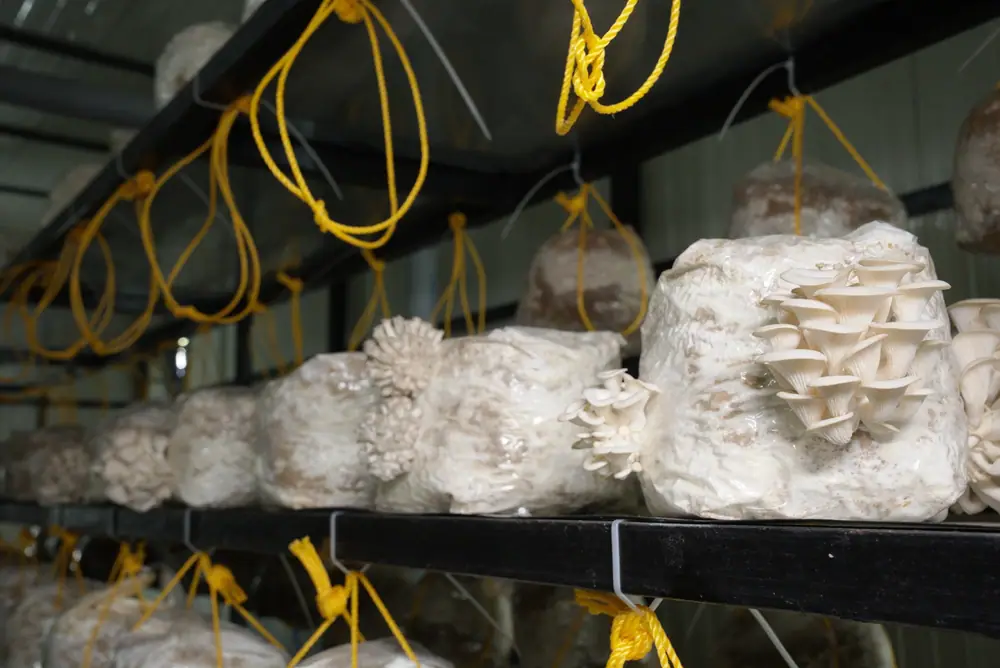
Oyster mushrooms need cool, moist air to fruit. Tamil Nadu Agricultural University’s growing guide says to keep the cropping shed at 23–25 °C with a relative humidity of 80–85 %,1 and the monthly advisories of ICAR’s Directorate of Mushroom Research give similar ranges, adjusted for the season.2 Chennai is too hot for oyster mushrooms to fruit well in the open, so ours grow indoors, in insulated rooms that are cooled, misted and ventilated.
The rooms
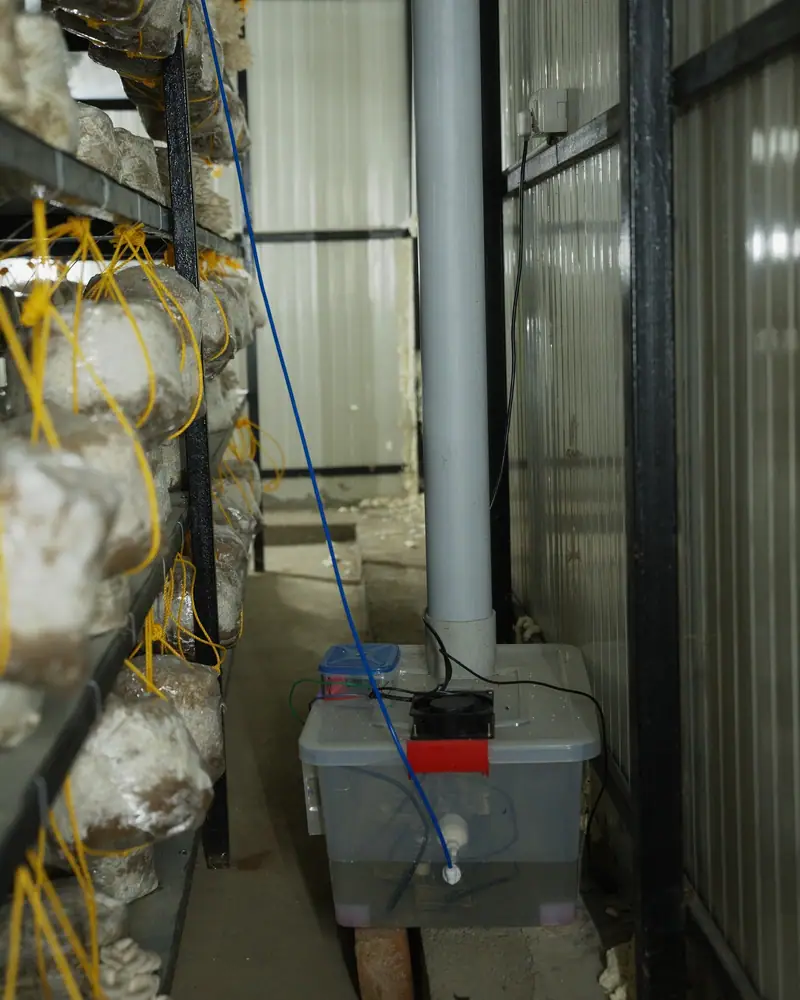
Our rooms are insulated with sandwich panels and lined with steel racks. Split air conditioners cool them. Humidifiers fed with RO-treated water keep the air moist once the mushrooms start to form, and exhaust fans with louvred shutters clear the air.
In September 2026, the installer reported automatic controls for the exhaust fans and humidifiers fitted and working.
Making the bags
We make our own grow bags on the farm. Wood pellets are soaked in hot water and loosened in the bag, the bag is taped into a cylinder, spawn is added, and the bag is sealed and then pierced by hand. We have tested different pellet substrates side by side.
Hanging the bags
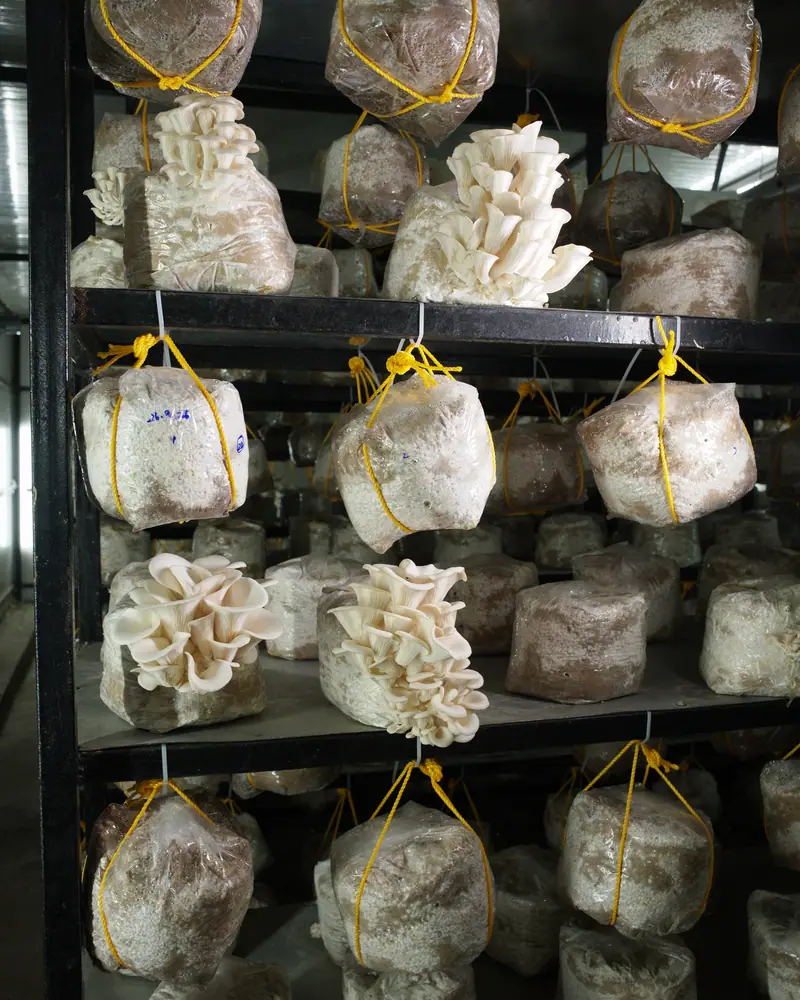
The bags hang from the rack shelves on rope loops, a method the farm worked out for itself.
Spawn run to pinheads
Over the following weeks the mycelium grows through each bag and turns it white (what mycelium is, and how it fruits). Through this time we keep the air fresh, with the aim of holding CO₂ in the rooms below 650 ppm. Once pinheads form, the humidifiers are switched on.
Reading the rooms
We read the temperature, humidity and CO₂ in our rooms with a handheld meter. From July to September 2026, the readings were logged each morning in the farm’s daily report.
Harvest and the next flush
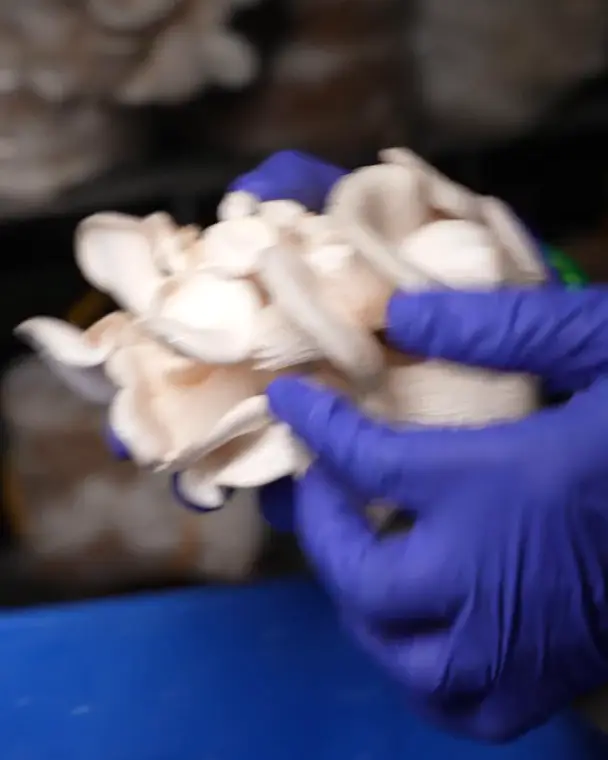
Harvest starts early in the morning, as Tamil Nadu Agricultural University’s guide also advises.1 The mushrooms are picked by hand and picked dry. After each flush, the bag is cut in an X, so that the next flush forms from the cut.
Grading, packing, chilling
The mushrooms are graded by size, packed by hand into 200 g punnets, labelled on the farm’s own label printer and chilled. Anyone harvesting or packing wears a head cover, and a harvest that is not good enough is not sold.
What went wrong, and what we changed
In August 2026, green mould appeared in one of our rooms. Green mould is a common problem in oyster mushroom growing, caused by a fungus called Trichoderma.3 Bags were moved out of that room, and the room was disinfected.
In September 2026, heavy rain let water into the central area of the farm, and the bags were covered with tarpaulin. The same month, one room ran too wet, so its humidifier output was turned down.
Read on
Sources
- “Oyster mushroom: cropping, harvesting and package”, Farm Enterprises: Mushroom. Tamil Nadu Agricultural University. Tamil Nadu Agricultural University website. Read on 30 October 2026.
- “Crop Advisory” (monthly advisories). ICAR-Directorate of Mushroom Research, Solan. dmrsolan.res.in. Read on 30 October 2026.
- “Training Manual on Cultivation of Oyster Mushroom”, edited by Ereneus K Marbaniang. Krishi Vigyan Kendra West Khasi Hills, ICAR-ATARI Zone VII. kvkwestkhasihills.nic.in. Read on 30 October 2026.